HRD

HRD Software, LLC has released version 5.11a of Ham Radio Deluxe, the first version since their acquisition of HRD from Simon Brown, HB9DRV.  The release appears to be a minor update with the most notable changes being cosmetic updates to splash screens, showing the new ownership of the product.

As many predicted at the time of the acquisition, the next version of HRD, 6.0, will be a pay-only product.  The 5.x version will continue to be free and will have bug fixes released for an unidentified amount of time.  Version 6.0 will be released at the Dayton Hamvention, but customers can receive a $20 discount for the product by subscribing to HRD support for $59.95 prior to Dayton.  At Dayton and afterwards the price for 6.0 will be $79.95.  That is a one year subscription.  Subsequent support subscription renewals are $39.95 for two years of support.  The software doesn’t expire and can continue to be used after support expiration, however users must have a subscription in order to get software updates.

Personally I think Ham Radio Deluxe is worth this price.  As I’ve mentioned in previous posts, I think it’s the best amateur radio logging software ever written (though in a sea of outdated and badly designed sophomoric applications, the bar is often set low).  But considering how good version 5.x is, it may take quite awhile for people to actually want or need to upgrade.  Unless the trial version of 6.0 really knocks my socks off, I’m going to wait until perhaps version 6.1 or 6.2 to consider upgrading.

Decisions

Yesterday while I was continuing my research into new rigs, my TS-850 stopped working with a dead silent receiver.  I pretty much wrote off the rig thinking it wasn’t worth the repair and I would be getting out the credit card and picking up the phone to place an order for its replacement.  But my good friend K3PH happened to see my rig death announcement on Facebook and posted a link to a Kenwood service bulletin about a known issue with Kenwood 850 receivers going dead.  For giggles I opened up the rig and checked the “RXB” voltage point, and sure enough it had the symptoms of the issue.  I replaced one culprit SMT diode with two run-of-the-mill 1N914 diodes and the rig came back to life.  As if that wasn’t enough, the CW QSK is now much better, with full break actually much quieter and smoother than before.  It’s like the rig has a second lease on life.

So for now the decision that seemed eminent is postponed while I enjoy my reborn Kenwood 850.  I’m still mulling over the choices for a new rig, but I think I have it down to the Kenwood TS-590 and the Yaesu FT-950.   Despite my initial thoughts of abandoning Kenwood altogether, the 590 seems to have some of the old Kenwood flair I liked years ago.  I’ve ruled out the K3, KX3, and Ten Tec Jupiter.  The Ten Tec Eagle is getting pushed out of the race.  I haven’t seriously considered Icom, but perhaps I should take the extra time to look at them.

So far the Kenwood and Yaesu offerings are neck-and-neck in the race, though from review comments, going through the manuals, and my experiences with other Yaesu products, I get the feeling the Kenwood interface may be more user friendly than the Yaesu menus.  I do like the front CW key jack, the separate RCA REC and PTT jacks, and the rotator integration feature in the Yaesu.  I wish I had an amateur radio store nearby I could touch each of these rigs.

Last night I operated during the CQ 160 phone contest with the 850.  I ran 100 watts to an inverted L with a meager seven or eight short radials on my acre lot, and I worked all but perhaps four or five stations in the midwest who couldn’t hear me.  It was like shooting fish in a barrel and quite fun, and really speaks to what you can do with a modest antenna on 160.

nanoKeyer

I’m pleased to report that Oscar, DJ0MY, has created an open source hardware initiative and kit offering called nanoKeyer.  This project utilizes my Arduino keyer code and the Arduino Nano, a smaller cousin of the Arduino Uno, but fully software compatible.

Oscar is offering the kit at a reasonable price, but also provides Gerber files on his site for those wishing to reproduce the hardware design.  The hardware kit features three memory buttons, a speed potentiometer, a PS2 Keyboard connector, and optically-isolated keying and PTT lines.  The Arduino Nano module that mates with the nanoKeyer supports the K3NG keyer code command line interface and K1EL Winkey emulation via the built-in USB port.  The Arduino Nano is programmed via a typical Windows, Mac, or Linux machine with free software.

This kit offers commercial / contest quality performance and features in an open source package that can easily be assembled by beginners or customized by advanced experimenters.

Choices

Lately I’ve been thinking (again) about getting a new rig and replacing an older Kenwood.  I’ve actually cleaned up the shack a bit and have removed some little monoband rigs that I rarely use and have gotten down to the basics of just what I need.  I feel I need something new in the shack, I’m just not sure what.

The Elecraft K3 would be a no brainer choice.  While it’s a great rig, it somewhat has the makings of a fad for me, and I’ve never been a trend follower.

The KX3 is another option.  I kind of like the idea of a portable rig that has the potential for being a primary home shack rig at 100 watts.  But I still have concerns about the form factor, with the rig being so small and for portable backpack use it seems a bit fragile.  I don’t know if I could be satisfied with it as a home base rig.

I would love to try a Flexradio, however each day I’m leaning more towards Mac in the shack (gasps from the audience).  The last time I looked at Flex they still weren’t supporting Vista or Windows 7.  Perhaps that’s changed but support for OSX is likely light years away.

Nothing that Kenwood currently offers excites me.  Unfortunately I doubt I’ll ever buy a Kenwood HF rig again.

Maybe I should go with a Yaesu rig?  The FT-950 looks like a reasonable choice, though a bit uninspiring.  The price is right and it gets good reviews.  It appears to be a good performing rig without needless extravagance like multi-kilobuck contester rigs.  I’m quite pleased and familiar with the FT-817 and FT-897, so this rig would not be difficult to assimilate into the shack, though it doesn’t really get me into uncharted territory and it seems like a “safe” choice.

Perhaps it’s time I tried a Ten Tec?  The Ten Tec Jupiter is kind of spartan-looking, but interesting.  I like the clean look and under the hood it seems to have a lot of technology and power.  One downside I see is that the MARS mod is not readily available.  I modify all my rigs for DC to daylight transmit for emergency use and so I can use them as signal generators.  I’ve never used a Ten Tec but I know they are legendary performers.

I’ve used Icoms and I can’t say anything bad about them, they’ve just never been on my radar.  I’m not sure why.

Any thoughts from the studio audience on what’s a good $1K – $2K HF-6m rig these days?

Life’s Too Short

Harvey Adkins, K1ZWK, was found dead in his apartment in New Haven, CT this week of apparent natural causes.  Adkins was first licensed in 2000, shortly after retiring from over 30 years of service at Lockheed Martin.

“He was an engineer’s engineer.”  said Walter Roomberg, a former co-worker.  “Any challenge you placed in front of him he would attack with vigor.  He was always trying to do “one better” than anyone else and would always succeed.”

“After he retired, Harvey was bored and needed something to do.  He knew about amateur radio for years, but dismissed it as too simplistic.” said Roger Smith, a local ham friend.   “At work he was on complex high tech multi-million dollar defense projects.”

We spoke with Adkins’ ex-wife, Mildred.  “We divorced in 2010.  He had always been successful all his life but was failing at this new thing he was working on with his radios called QRP.  It became an obsession and he was failing at it.  It took such a toll on our marriage that I had to call it quits after forty years.” she said sadly.

Adkins excelled in amateur radio radio shortly after getting his ticket.  He acquired Worked all States on four bands within his first three months.  DXCC was achieved a few months later and within three years he was approaching the honor roll.

“Harvey operated all the modes at that time, except for CW and some of the slower digital modes.”  stated Smith.  “He had to learn the code in order to get his license, which he did easily, but he had no interest in CW.  He saw it as slow, simplistic, and too low tech, and enjoyed the ease with which he could conduct a conversation with other modes.  In additional to phone ragchewing and DXing, he was doing all kinds of cool stuff like EME and writing his own DSP software, using the engineering capabilities he developed in his professional career.  ‘Life’s too short for CW!’ he would say. ”

Another club member, Elmer Keglovits, gave a similar profile of Adkins.  “He was the Renaissance man of amateur radio.  He did it all.  Some modes he briefly did but found too mundane or just not that challenging.  PSK31 was one of those modes.  He tried it for a short time but found the nature of it, macros and all, to be a bit mindless and boring.  But he would never put down the mode, and if you ever asked him about PSK at a meeting, he could immediately tell you exactly how it worked and even draw on the whiteboard the modulation technique.  It was the same with CW.  He learned it to get his license and felt he knew enough about it, and moved on to other more interesting things, for him.  He wanted to try everything in amateur radio and learn the underlying technical details.  He didn’t find it necessary or worthwhile to dwell on modes that got in the way of his ‘journey of discovery’ as he often called it.”

“One night he was talking about his achievements at our monthly club meeting and someone chuckled and said that anyone could do what he did on QRO and phone and that if he wanted to be a real ham he should do all CW.  Something snapped in Harvey that night.” said Smith.  “Throughout his professional career he was accustomed to being recognized for everything.  He had thought he had reached the pinnacle of amateur radio achievement and was insulted, but also challenged by this.”

Adkins became introverted and isolated after the encounter, Rogers explained.  “After that night he changed.  He studied and practiced CW again and increased from a rusty 5 words per minute to 30 in a matter of two or three weeks.  It was amazing.  He made some contacts on the air, but he was frustrated as it seemed too easy to bang out quick QSOs, and he felt too encumbered to ragchew like he did on phone.  On the other hand, once enjoyable phone operation didn’t interest him anymore with the mode considered tainted, in his mind.  That’s when he vowed to go all CW and QRP.  He sold all of his gear at Dayton later and proudly purchased and built an Elecraft K1 and began operating a relatively spartan station compared to his previous setup.  But for some reason he just couldn’t make a contact, any contact, at all with the rig.”

Rogers had offered to help Adkins determine what was wrong with his new radio, but Adkins steadfastly refused, seeing it as a failure if he had to seek help.  “At that point our relationship deteriorated.” said Rogers.  “He had gone for about four months without being able to make a CW QRP contact.  He bragged in an email to the QRP-L reflector about diving into the QRP CW lifestyle and how much he was enjoying it, but unfortunately was banned for life when he mentioned a Rockmite that he had acquired on eBay.”

The ban from QRP-L added to his angst and focused him even more, but his downfall was beginning.  He began gaining weight, his marriage fell apart apart and after a messy divorce funds were limited so he had to move into an apartment where no outside antennas were allowed.  This fueled the obsession, with the necessity of stealth antennas adding to the challenge.  Two years later and fifty pounds heavier he still had not made a QRP CW contact.

“Local hams could hear his signal very weakly, but no one dared work him.”  said Rogers.  “Knowing Harvey, we didn’t want to ruin his challenge.  We weren’t rare DX so it probably would have made him go over the edge if someone a mile away worked him.”

But Harvey was already going over the edge.  Analysis of files on his computer showed that he had created an anonymous email alias and fake callsign and was frantically emailing QRP-L.org, the other main QRP “watering hole”, for suggestions.  Unfortunately his emails were HTML formatted which was forbidden by the reflector, and his emails were silently discarded without anyone seeing them or responding.  The lack of response which mimicked his on air struggle was apparently more than Adkins could bare.

After nearly three years of no QSOs, Adkins was found dead in his apartment full of Elecraft rigs, Rockmites, straight keys, and various homebrew stealth antennas.  Roger Smith acquired all of the rigs and coordinated an estate sale at the request of estranged relatives who declined to be involved.  “Each rig was modified.  There was a resistor pad on the output of each one, reducing the power output.  Apparently five watts was too much power for him, or he thought someone would up the ante on him again with an even lower power challenge.  All of his rigs were putting out less than a milliwatt.  It was very strange.”

No services are planned for Adkins, however local amateurs are planning to honor him by acquiring his ashes and compressing them into an Altoids tin and storing them at their clubhouse in New Haven.  Harvey Adkins was 74 and is survived by two children and one grandchild.

Raspberry Pi

The Raspberry Pi, which is a 700 Mhz ARM-based single board computer targeted at providing computing hardware to poor countries is going to be going into production soon.  Two models called “A” and “B” are being offered, at approximately $25 and $35 (US).  Options to purchase boards and donate money to provide units to needy folks around the world will be available.  

The concept of single board computers isn’t new, but the horsepower and price point of these units are.  At this price range it puts the boards squarely in Arduino territory, but unlike the Arduino and other microcontrollers it will run a full blown OS.  Several Linux distributions will be supported immediately and presumably BSD variants won’t be far behind.  It will not run Windows or Windows emulation, like WINE.  (Yes, I know WINE is not an emulator).

The board is equipped with a USB port that obviously can be used to interface with a multitude of devices, however it also includes a General Purpose I/O port or GPIO that supports, PWM, Serial UART and I2C capability.  This will open the board up to hardware hackers like us.  Sweet!

I’m pondering what amateur radio applications this could run.  It has enough horsepower to do DSP.  It would make a nice logging and contest appliance, with  some well-designed software.  How about an EchoLink or digimode appliance?  Considering the low price it’s almost disposable and could make a powerful hot air balloon radio payload system controller.  I may port my keyer code over to it for giggles.  It will be interesting to see what uses radio artisans come up with.

Kudos to CQ

Often I complain about what we’re doing wrong or what we should be doing.  This time is one of those exceptions where I have to pass kudos along.  CQ Magazine has announced a “Maker” column which will be edited by Matt Stultz, KB3TAN, and will appear in several issues this year.  The so-called maker movement has always been around, it’s just recently become more “hip” with the “maker” moniker and like with amateur radio the Internet provides a means for tinkerers to network, exchange ideas and information, and come together as a more organized movement.  In my opinion amateur radio missed two prime opportunities with techie movements in the past, that of the open source world / Linux, and the wifi boom in the late 90s, early 2000s that led to wireless ISPs and got a lot of geeks interested in wireless but without amateur radio.

It’s great that CQ recognizes the opportunity and is taking advantage of it to bridge the maker and amateur radio worlds, and it just makes sense from a technical standpoint to introduce amateur radio to makers.  Maker projects often have an element of mobility or remote control — projects that need wireless for control or data telemetry.  Rather than just purchasing a mystery “black box” radio unit off-the-shelf and incorporating it into a project, makers have the opportunity with amateur radio to understand what’s going on inside the box, or bettet yet build that black box themselves.  Introducing amateurs to the maker world will be beneficial as well, hopefully encouraging more amateurs to build and perhaps build projects outside of the normal QRP rig projects we tend to do.  Overall this is a win-win situation for radio amateurs and makers.

Back to the Lab

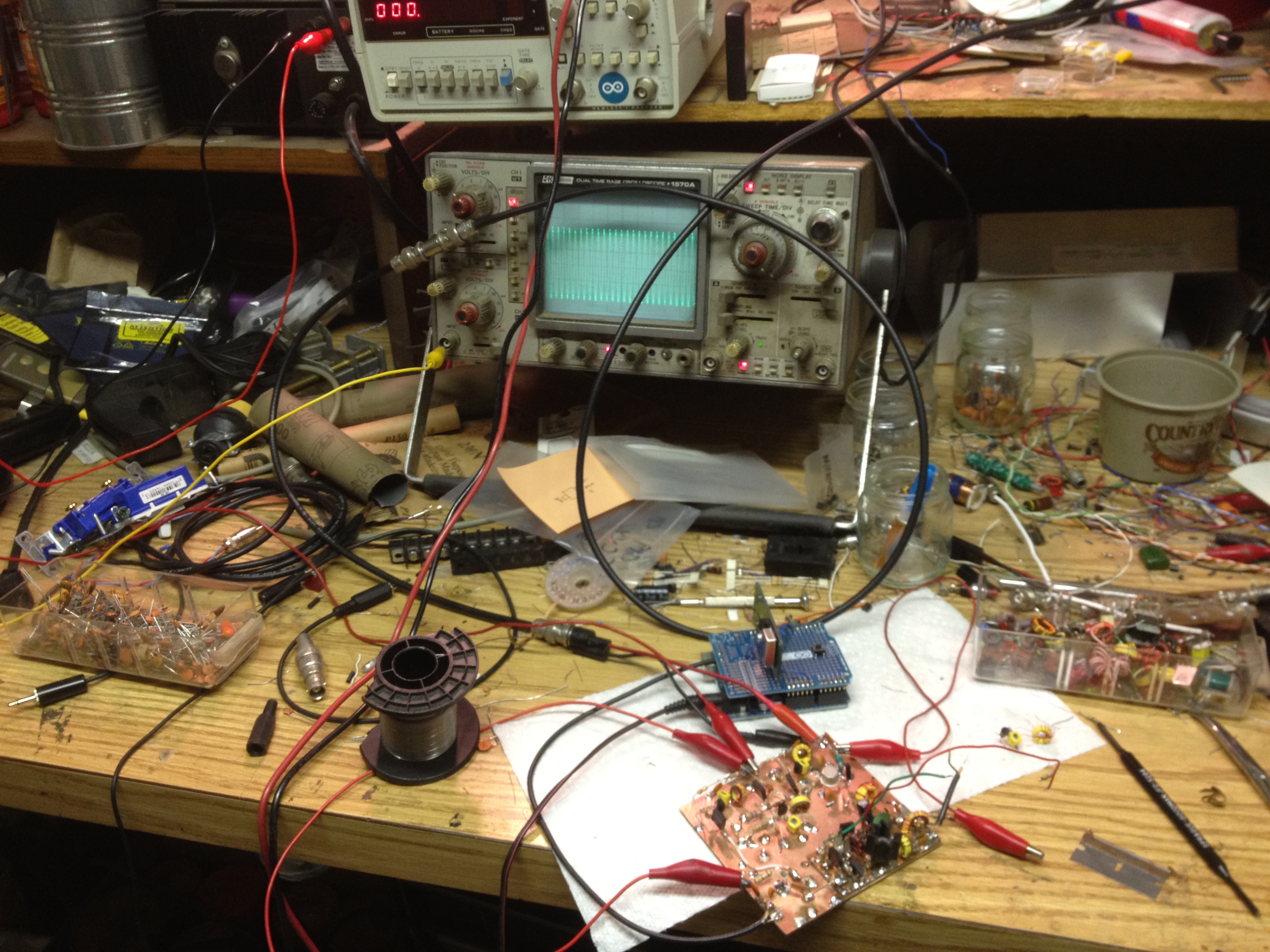
Here’s a project I’ve been working on which kind of started on a whim a few days ago.  I’ve had two NJQRP DDS Daughtercards lying around, the older versions without the output amp update.  I decided to interface one permanently to an Arduino and build a dual 10 and 6 meter beacon.

Is your lab as messy as mine?

The Arduino alternates the DDS frequency between 28 Mhz and 25 Mhz and CW keys the amplifier board.  For the six meter transmitter chain I’m doubling the DDS 25 Mhz output to create the 50 Mhz six meter signal.  Output power on each band will probably be around 250 mW.  I’m probably going to put the unit in a weatherproof box, install it in the backyard, and attempt to power it with solar power.  In addition to doing the CW keying and DDS programming, the Arduino will also measure and announce the battery voltage and perhaps the solar panel charge current.  For antennas I’m thinking of simple wire loops.

Several years ago I ran a 100 mW ten meter beacon.  I like lower power beacons; it’s more of a treat when people report hearing them.  The previous ten meter beacon got quite a few DX reports from Europe during the last solar cycle.

Interference

Undoubtedly some of you radio artisans have been following the LightSquared spectrum fiasco.  For those of you who haven’t been, in a nutshell LightSquared is a US company that is attempting to deploy a 4G mobile wireless network on 59 Mhz of real estate that’s right next to the GPS band.  Their plans have been halted due to concerns about interference to GPS services, used by consumers, industry, and the military.  Technically the problem is due not to LightSquared’s technology directly, but rather deficiencies or design limitations of millions of GPS receivers in use.

For a solution to this difficult interference issue, perhaps the FCC should look to a past interference situation, that of Broadband over Powerline, or BPL.  Here are some ideas, some that came directly from BPL vendors and advocates or the FCC, and others just in the “spirit” of BPL:

Regulate it under Part 15.  Part 15 states that a Part 15 service can’t interfere with licensed services.  So, everyone should be happy, right?  If someone experiences interference, like with BPL they can contact LightSquared and hopefully have the issue resolved in 6 to 36 months.

Declare no protection for mobile operations.  Like mobile amateur radio operations and BPL interference, GPS users can just walk or drive away from LightSquared towers or cell phone users.  Interference problem solved.  Only stationary users of GPS should be able to file interference complaints.  This would include people using GPS in their living rooms.

Create an online database of LightSquared towers and cell phone users.  As with the BPL database, GPS users could query it to determine if they are experiencing interference from a LightSquared tower or device and determine where in the US they can relocate to avoid the interference.

Claim that interference to military GPS users really isn’t an issue.  The military really only needs GPS when there’s a war going on.  Most people in war zones aren’t making phone calls and LightSquared probably won’t be deploying towers in Iran, where our next war is likely to occur.

Point out that 4G wireless services are new technology and GPS is old.  GPS development began in 1973, 39 years ago.  Why are we still using this old, antiquated technology?  4G wireless is new, it creates jobs, and people can use maps instead of that old GPS.

There is always a simple solution to a complex problem.  BPL was the no-brainer solution to the broadband crisis.  The FCC just needs to dust off its BPL files and apply the same technical expertise and creativity that solved the BPL interference problem and made it the success it is today.

Yaesu Digital Voice

Yaesu has been in the news recently for the digital salvo they fired over the bow of the D-STAR ship.  In theory I think this is a great move, and others are praising Yaesu’s announcement.  My concerns with D-STAR’s proprietary AMBE vocoder algorithm and hardware, the essentially one vendor market for D-STAR equipment (Icom), and the relatively dated and unscalable D-STAR protocol are no secret to anyone who reads this blog regularly.  But looking at the Yaesu digital voice whitepaper, it’s somewhat a half-baked initiative, in my opinion, where Yaesu has a new hammer and everything looks like a nail.

Most of the paper focuses on the modulation technique of D-STAR, GMSK, and pits it against Yaesu’s (errr….. Motorola’s)  C4FM.  While better RF and data throughput performance can be had with better modulation techniques, the big issue with D-STAR isn’t its modulation technique, it’s the layer two protocol.  Yaesu doesn’t even mention its layer two protocol and network that would presumably be used, Wires II.

Yaesu’s case for C4FM superiority beyond it being used in commercial networks falls flat.  In the paper there are specifications of selected D-STAR and C4FM radios compared, with some highlighted parameters.  There’s also a graph comparing various modulation techinques, but the big takeaway is D-STAR has a rate of 4800 baud versus 9600 baud for C4FM.  I’ve used the somewhat archiac term of baud rather than kpbs intentionally to illustrate just how lame the comparison is.  Furthermore, while D-STAR is clearly in the crosshairs of Yaesu, there is no mention of D-STAR’s 128kbs data mode or how Yaesu’s solution beats that data rate.

All in all this whitepaper and initiative which some are praising appears to me to be a rather sophomoric effort, and one more concerned with selling retreaded commercial rigs in amateur radio.  Aligning amateur standards with commercial ones isn’t a bad thing especially when secondhand commercial gear can be re-purposed for amateur use, but there needs to be other compelling reasons to adopt a commercial modulation technique. Even with the best layer one modulation technique, if the layer two protocol and the supporting network is badly designed the digital voice standard is doomed for failure.  Yaesu needs to be making a case for its system by explaining the entire network, how it is open and non-proprietary, and how it will scale in the future.  I hope Yaesu does successfully launch a competing digital voice solution, and I hope organizations like ARRL and RSGB get involved and insure that the standard is consistent with the spirit of amateur radio.  Unfortunately to me this new initiative looks like another D-STAR in the making.

(D-STAR is a registered trademark of Icom Incorporated.)