Hiram’s Father

There’s an interesting BBC article involving Hiram Stevens Maxim, the father of Hiram Percy Maxim who was the founder of ARRL and a mover and shaker in the nascent world of wireless back in the early 20th century.  Both Hiram junior and senior were inventors.  Hiram senior invented several items but was known most for the Maxim machine gun, the first portable firearm of its kind.  Outside of the radio work we know him for, Hiram Percy Maxim also invented a silencer for firearms and what was essentially a muffler for car exhaust systems.

A contemporary firearms engineer and inventor in Europe named William Cantelo mysteriously disappeared in the 1880s when he went on a road show to sell his new invention to investors and manufacturers, a repeating firearm.  Cantelo, his body, or evidence of foul play was never found, however rumors of him being in America were circulated.

To add to the mystery, the resemblance between Hiram Stevens Maxim and William Cantelo is quite striking.  The similarities in appearance along with their common talents in firearm inventions led to claims that Maxim was really Cantelo.  This has never been proven, and it’s been written that Hiram Stevens Maxim was not interested in engaging the Cantelo family’s questions about his identity.

The Mystery of the Vanishing Gun Inventor

KQ?

wtf-catDid you ever hear a DX station calling KQ, all stuck together like a prosign, instead of calling CQ?  I’ve heard this several times in recent years and I’ve wondered what’s up with that.  Is it too difficult to throw the extra dit in there?

But I digress….

Homebrew Engine

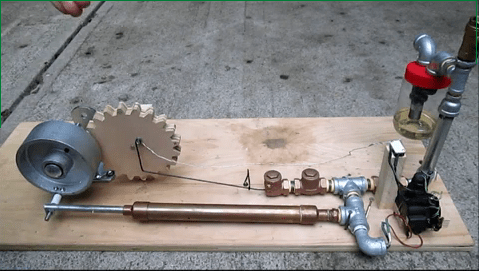
Here’s a cool little video from HowToLou.com (I’m guessing this guy is named Lou) with a third prototype of a homemade engine made strictly from hardware store parts.  It’s not quite working yet, but it’s rather interesting and I think he’s on the right track.

I’m more electronically inclined than mechanical and have some ideas on how to make the timing of the spark and the exhaust valve better, using electronics.  But I probably couldn’t do it with just hardware store parts, unless perhaps the hardware store sells radios that I can scrounge parts from.

One of these homebrew engines coupled with a homebrew generator connected to a QRP rig would make a nifty little project to show at your local ham club or field day.

Your Own Drone?

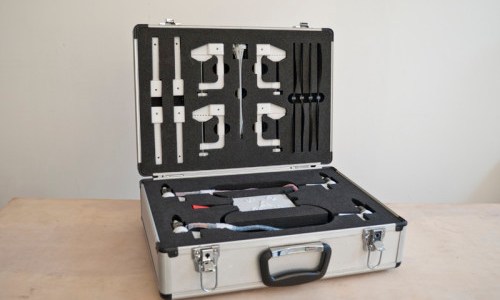
The Drone It Yourself is a kit to take ordinary objects and turn them into flying remote-controlled drones.  The concept is simple: clamp four electric motors with propellers and a control unit onto whatever object you desire, and fly it around the neighborhood.

While it may be fun to terrorize the XYL or spy on the neighbors with this, I see this possibly having some useful real life applications in amateur radio.  I’m not sure of what kind of battery life this unit has, but imagine hovering a remote controlled HT at 80 feet for an ad hoc repeater.

A guy could really get into some trouble with one of these :-)

Encryption Is Already Legal, It’s the Intention That’s Not

Fresh from the Unless You’ve Been Living In a Cave, You’ve Heard of This department, there’s been much ado over the FCC Petition for Rulemaking seeking encryption for emergency communications.  I won’t go into the details of the petition as you can read that several places elsewhere.  Technically encryption on amateur radio bands is illegal.  However, in reality the FCC has been letting it happen for years and the ARRL has turned a blind eye to it.  D-STAR uses a proprietary vocoder that takes an analog voice signal and converts it into a data bitstream.  The algorithm isn’t publicly documented and you can’t decrypt it, unless you buy a proprietary chip.

Some may quote § 97.309 (4)(b) which basically says one can transmit an “unspecified digital code” as long as the digital code is not intended to obscure the meaning of the communication.  Presumably the people who created and use D-STAR don’t intend to obscure the meaning of the communication, so perhaps it is within the law.

So, say I create a new digital communication mode.  It features a compression algorithm and I just happen to XOR the data stream with a 10 million bit pseudorandom bitstream to randomize it so a long stream of zeros or ones won’t screw up a modulator.  I document the algorithm and the 10 million bit key on some corner of the Internet.  It’s technically publicly documented, but in practice no one will go to the trouble of attempting to build a decoder.  I’ve achieved encryption in a roundabout way.  Whether my intentions were to obscure the meaning of the communications or make a modulator-friendly bitstream is anyone’s guess.  But with the inaction over the D-STAR vocoder and the wording of § 97.309 (4)(b), intention rules the day.  So while this debate over the petition is being framed in a discussion of encryption, it’s really the intent to obscure communications that’s at the heart of this.

I don’t have a horse in this emcomm race, but I’m not in favor of allowing obscuring messaging.  If the FCC does allow it, others are going to want to use it for their noble causes, like preppers under the guise of “homeland security”.

(D-STAR is a registered trademark of Icom, Inc.)

Project Loon

Google has announced Project Loon, an experiment to use balloons aloft at about 60,000 feet / 20 km to provide broadband wireless Internet service to the hinterlands.  The Loon moniker is somewhat of an admission that the project is a bit crazy and a play on the word balloon, but it does have a sound technological foundation.  The technology is much cheaper than satellites and naturally easier to launch.

projectloon

The experiment is beginning this month with the launch of a handful of balloons from New Zealand which will orbit about the 40th parallel and navigate around New Zealand using varying direction and magnitude air currents at various levels.  Beta testers have been selected in New Zealand to try out the system.

The idea of using aircraft to provide wireless services isn’t new, and radio amateurs have been launching experimental balloons with radios for quite awhile although recently there has been an upshot in interest.  Google is known for using open source software and contributing open source technology back to the community.  I’m curious if Google will open source the hardware, perhaps enabling amateur radio to benefit with its own balloon network similar to this someday.  Current typical amateur radio balloon missions last only a few days.  Having several balloons aloft could perhaps be an alternative to satellites which are becoming increasingly expensive and difficult to launch.

The Project Loon site has a nice video detailing the project here.

What’s Going On?

Since creating the Radio Artisan discussion group, I haven’t been frequently posting progress reports on my various open source amateur radio projects, but needless to say progress and interest in these projects continues to build.

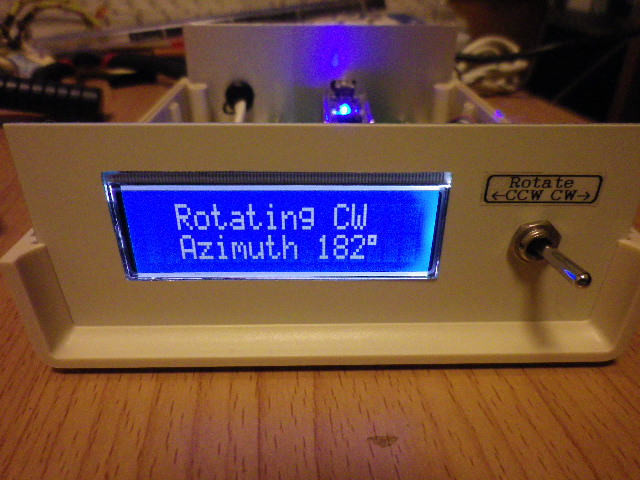
The project that has been garnering the most attention in recent months has been the Rotator Controller.  Ironically, I personally use this project the least in my shack, but I get emails nearly daily for new features or support requests, with a lot of interest coming from Europe.  Previously I called it the “Yaesu Rotator Controller Emulator”, or something to that effect, but I’ve dropped Yaesu from the description as it’s gone significantly beyond my original intent of just interfacing to my Yaesu rotator.  It now supports the Easycom protocol, several azimuth and elevation sensing methods, including rotator encoders, pulse inputs, digital compasses, and accelerometers.  It’s also now possible to place a remote unit at the tower and a host unit in the shack, in sort of a client-server fashion, to support I2C sensors on towers and automate other stuff like relays.  I’m amazed at how many people out there are wanting to interface old rotators to their computers or build their own homebrew rotators.  Karl, JA4BUA, has this site with pictures of his implementation of the rotator controller, complete with an Eagle circuit design.  I’m impressed with his workmanship, with his creation looking much like a commercial piece of equipment.

roter3

Photo courtesy JA4BUA

The CW Keyer project has CMOS Super Keyer timing in beta and native USB keyboard support is in the works.  Currently PS2 keyboards are supported, but these seem to be getting less common these days.  I also have in the works a full LCD menu system.  The MJ/ON6NB DXpedition will be using a DJ0MY Nanokeyer running my keyer software later this month from the island of Jersey.

The Ardiuno Antenna Tuner is still in alpha, however I’ve been using my first prototype in the shack for some time now and it’s working quite well.  It puts the two commercial tuners I own to shame.  Needless to say it’s a much more complicated project than the keyer or rotator controller.  I’m working on a hardware design using an ATMega1284P chip that can be replicated and will hopefully encourage others to build it.

I’ve been intending to write an article on KiCad, an open source electronic design tool, similar to Cadsoft Eagle.  I migrated to KiCad a few months ago, and it’s simply amazing.  It runs on both Windows and Linux, and the user interface isn’t compromised on either, looking nearly identical and rather polished for an open source project.  Many people are using it professionally, though it doesn’t appear to have the same hobbyist following as Eagle, yet.  There are a few downsides to KiCad at this point.  Management of component and footprint libraries is less than intuitive and needs some work.  Development is quite active with updates being released almost daily, which can make for some feature instability.  But on the positive side, component design is much easier than Eagle, it has no limitations like the free versions of Eagle, and it’s definitely capable of producing professional quality designs.  If you’re doing circuit design you really need to check out KiCad.

In closing, I’ll say it’s a great time to be building stuff in amateur radio.  On a daily basis I’m amazed at the ingenuity and creativity radio amateurs have.  We can build great equipment, beyond radios and antennas.  Sure, it’s difficult to find a good air variable capacitor these days, but we have access to sophisticated components, modules, design tools, and computing power well beyond what our predecessors had.  We have the means to exchange ideas, information, and designs more easily than ever.  We are truly lucky.  What have you built lately?

New Radio

Well, I finally broke down and bought a new rig this week.  You may recall I was debating between a Yaesu 950, Kenwood TS-590, Elecraft K3, and Ten Tec Eagle.  I ended up buying a Kenwood TS-590.  What led to my decision, you ask?
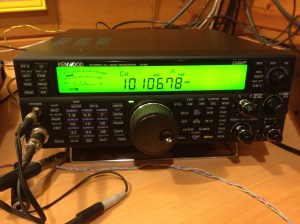
photo (4)

The simplicity of the Ten Tec Eagle is nice and refreshing, but I just couldn’t bear spending over $1,800 for such a simple rig.  It bugged me that the MARS mod wasn’t readily available.  This is one of my idiosyncrasies; any rig that I have must be able to transmit on whatever bands its capable of transmitting on, and I abhor hardware limited by software.  And for over a kilobuck, can’t Ten Tec spring for a second antenna connector?

Volumes have been written about the Elecraft K3, and any review below a 5 out of 5 gets dirty looks from the studio audience.  Yes, it’s a great rig, and initially it looks like a great deal until you start adding on the add-ons you really need to operate this rig.  Right off the bat it’s $2,100 for a 100 watt rig.  If you’re like me you’ll want a CW filter, a tighter phone filter, perhaps one to listen to and operate AM, and the general coverage filter band pass unit, and you’re looking at another $580.  Also, the chassis of the K3 is below what I would consider for a rig in this price class.  It’s not badly designed, but it’s really time Elecraft puts the big boy pants on and makes a die cast chassis.  I know someone will quip that the Yaesu 950 and Kenwood TS-590 receivers aren’t as good as the K3.  You’re absolutely correct.  Is that extra few dB of IMD performance or receiver sensitivity really worth an extra $500 – $1K?

I was torn between the Yaesu 950 and Kenwood TS-590.  Two things tipped the scales in Kenwood’s favor.  A read several reviews about the Yaesu’s multiple roofing filters being not that useful, however they made it a major part of the user interface on the front panel.  The other mention was Yaesu’s menuing system.  Having three Yaesu products currently I’m quite familiar with Yaesu’s menus, however I can’t say I really like them.

A few reviews of the Kenwood TS-590 indicated better performance on CW than the 950.  Admittedly I wanted to give Kenwood another try after their HF “design drought” of eight years, my fond memories of Kenwood back in the 80s and 90s, and the 850 I have has given me lots of great service for 14 years.  I was a bit nervous about the TS-590 having operated a TS-570 years ago at Field Day and being disappointed in the receiver, however Kenwood literature, which was quite extensive, indicated that the 590 was designed anew from the ground up.

The TS-590 so far hasn’t disappointed me.  I was able to figure out nearly all of the functions in the first 15 minutes without cracking open the manual.  Power, mic gain, and VOX settings are easily accessed with single keystrokes and don’t require menu navigation.  The menu is accessed via a button aptly labeled MENU.  The knobs have a quality feel to them and the front interface is consistent and well laid out.  What don’t I like?  Two items: the number keypad on the left side has the bands (1.8, 3.5, 7, 10, etc.) as the primary marking on the buttons and the number (1, 2, 3, 4…) are secondary, which gets confusing when doing direct frequency entry.  The second item is the CW QSK.  Much like my TS-850, it makes more relay noise than I would like, however it sounds good in the headphones.

The manual is very well laid out, and doesn’t have the Japanglish commonly found in older Kenwood manuals.  The rig achieves a nice balance between simplicity and complexity, not being overly flashy and offering a straightforward and useful display.  The free software controls every aspect of the rig, down to the AF and RF gain and power, and it’s a rather well designed and intuitive application.  New firmware can be uploaded to the rig as it becomes available.  I especially like the filter controls which are on one knob.  In CW mode it acts in shift and width mode, and in phone it changes to lo cut / high cut, which makes a lot of sense.

Overall, I’m pleased with my decision, and hats off to Kenwood for a nice little rig.  Sorry Yaesu, but let me know when you have an FT-817 replacement out and we’ll talk.  :-)

 

FCC Relinquishes Amateur Radio Licensing

fcc-logoIn a shocking and unexpected move, the FCC today transferred all amateur radio licensing responsibility to QRZ.com, releasing Report and Order 2013-699.  Outgoing Chairman Julius Genchowski read a statement noting that the decision was due to a combination automatic budget cuts from budget sequestration and an acknowledgement of reality.  Other commissioners released similar written statements.  The Report and Order stated,  “Our enforcement bureau received an inquiry from a radio amateur who was banned from QRZ.com (“QRZ”), an amateur radio portal and a popular callsign database.  After his callsign listing was removed from the QRZ database, amateurs frequently questioned on the air whether he was really licensed.  On a few occasions he was actually referred to as a ‘bootlegger’ by other radio amateurs, a derogatory term for an unlicensed individual operating illegally.  Our research indicates that few licensees actually use the FCC ULS [the official online licensing database] for amateur radio license queries.  In this ruling we have identified an opportunity to shed the responsibility of licensing and reduce administrative costs, and are therefore transferring administration of amateur radio licensing to a private entity.”

genachowski

FCC Chairman Genchowski Makes Announcement to Stunned Audience

At press time ARRL had not released a written statement due to a backlog in the ARRL email server, still processing emails from a month ago.  However, in a conference call this afternoon it was announced that ARRL was petitioning the FCC to withdraw the R&O until it could present its solution for privatizing amateur radio licensing, a solution employing 65,535 bit encryption technology which would be ready sometime in 2019.

QRZ praised the FCC change and announced that for a limited time free Extra class upgrades will be included with an XML subscription or purchase of Ham Radio Deluxe.  QRZ forums were abuzz, with both support for and opposition against the change.  One super moderator stated that QRZ super moderators will have enforcement privileges, with the ability to revoke licenses for bad behavior both online and on the air, later taunting to users to step out of line and “feel his wrath.”

The FCC announcement is the most notable change in US amateur radio licensing since the controversial and still-debated Incentive Licensing program, and will go into effect upon publication of the Report and Order in the Federal Register.