…if every radio amateur in the world had a QSO today…
…a sunny island beach, a vertical stuck in the sand, a little rig, and 10 meters is open…
…what a radio wave sees bouncing around the globe…
(Post your ‘imagine’ thoughts in the comments below…)
amateur radio journey
…if every radio amateur in the world had a QSO today…
…a sunny island beach, a vertical stuck in the sand, a little rig, and 10 meters is open…
…what a radio wave sees bouncing around the globe…
(Post your ‘imagine’ thoughts in the comments below…)
(This is an updated repost from my previous blog, The K3NG Report. Occasionally I will repost notable articles that are of a timeless nature. Reduce, reuse, recycle as they say.)

With antennas, it’s not about the feet and inches (or meters), think in terms of wavelength.
Don’t worry about the orientation of a dipole when it’s less than a half wavelength above ground.
In multi-multi contesting and big gun DXing it’s often more a battle of bank accounts than operator skill.
You’re going to go through several phases in your radio artisan career. Don’t spend too much money until you’re sure you like the phase you’re in.
Don’t gauge your success by the number of awards you have on the wall.
Your money is better spent initially in antennas than amplifiers. When you have the best antenna your budget and lot will accommodate, then go for an amplifier.
There are good CBers and bad CBers. More amateurs than you think got started on CB.
Don’t be nervous.
There are jackasses in amateur radio. You cannot identify them by license class, age, years licensed, call area, operating mode, education, or income.
When the bands are open any goofy antenna will make contacts. People will think this makes a goofy little antenna a good antenna. Not so.
The perception of amateur radio that the general public holds is much different from the perception within amateur radio. We’re in a strange, esoteric and sometimes archaic hobby that most of the world doesn’t understand. Welcome to our secret society.
It’s not that extra one or two dB that makes the difference, it’s the first 50 dB that really matters.
Girls actually dig letters written in Morse code while you’re dating.
Save your money and buy a crank up or tilt-down tower.
Six meters.
You can operate anywhere you live, no matter what the restrictions. About any piece of metal can be loaded up with a tuner.
You buy an HF quad only once.
Low SWR doesn’t mean it’s a good antenna. Dummy loads have a low SWR.
Don’t get your start on 2 meter repeaters.
It’s not difficult to become a proficient operator. It’s listening and learning that people often find difficult. You need to listen to what others who are successful do.
Ladder line.
Homebrew it, even if you’re not some master electronics designer. When building equipment, don’t worry about not being a EE or building the perfect circuit. Don’t bother making printed circuit boards, you can build just about anything you want Manhattan style. Experiment. You will learn more from your building failures than your successes.
Don’t fall in love with one brand of radio. 
Don’t limit yourself to one mode.
Join a club. Do what is fun and what you want to do in the club. As soon as others tell you what you should be doing, it’s time to leave. When being involved in a club feels more like a chore, get out. If the club is on life support and you can’t revive it in three years, pull the plug. Move on. Don’t look back.
QRP isn’t difficult. It requires persistence and patience….and knowing when to go QRO or when to QSY.
Life’s too short to argue with enlighten people who say life is too short for QRP.
If you are in a club you don’t like and you want to leave that club to create a new or rival club, list on a piece of paper why you don’t like that club. This list is why you shouldn’t start a new club.
Don’t do CW because you want to impress others.
Get an ARRL life membership (or whatever your national amateur radio organization is) as soon as you can afford it. Don’t worry, you will get angry at ARRL at some point, but you’ll save money on the magazine subscription. (And ARRL is about the only reason amateur radio is still around in the US.)
It’s never what you don’t know that bites you, it’s what you don’t know you don’t know that gets you into trouble.
Walk away when you need to.
In amateur radio do what you like, like what you do.
You’re in a great hobby for life.
The FCC has released a second Report and Order, affirming its rules for Broadband Over Powerline (BPL). The document is available here. It’s quite a lengthy mind-numbing read, but skimming through it, it appears the FCC has rejected changes to its previous findings over the past several years. Undoubtedly ARRL will have much reporting and analysis over the next few days. 
After eight years of trying to take hold, Internet access BPL has for all intents and purposes become a dead technology, not even being mentioned in recent FCC broadband reports. The BPL industry has been attempting to make inroads into so-called Smart Grid technology which will upgrade and automate electrical distribution networks. I haven’t been following this industry closely, but last I had looked they didn’t appear to be having much success. However the love affair with BPL at the FCC, and the OET in particular, lives on.

The code-writing squirrels at Radio Artisan Labs have produced another update to the Arduino Keyer code. This update provides a plethora of functions for the PS2 keyboard feature, increases the number of memories to 12, and the number of supported transmitters to six. I’ve never encountered the Ultimatic mode in the wild, but it’s now available as are Iambic A, Iambic B, bug, and straight key modes. Ham Radio Deluxe can now talk to the keyer, which can be used to provide a rather nice graphical user interface to most keyer settings and functions. A host of other logging and contest programs should interface with it as well as some kinks in the serial USB interfacing were worked out. And as if that wasn’t enough, the code now sports a GNU license like all good free software should.
The next features to be developed are an LCD display with eight soft keys and CW receive capability. The squirrels want to write some code that will automatically make QSOs while they’re on a DXpedition vacation in Aruba, wanting more time on the beach and less in the shack.
Hidden in a nondescript mountain location in eastern Pennsylvania, the highly trained squirrels at the Radio Artisan Lab have been working feverishly lately on the Arduino keyer code. Besides being amazed that squirrels can code in C or even operate computers in the first place, I’m amazed at some of the features they’ve been pumping out. Here are the highlights:
You can now plug a PS2 keyboard right into the keyer, no computer required.
The keyer interfaces with popular logging and contest programs with the new Winkey Emulation feature.
Iambic A and B modes are now available. Straight key and bug modes are also available as before.
Various timing niceties like wordspace adjust, keying compensation, autospace, and first element extension are now available, along with the existing PTT lead/lag and dit-to-dah ratio features.
There’s now a Dead Operator Watchdog. If you keel over mid-QSO and one of the paddles gets stuck, the keyer will stop transmitting so you won’t be QRMing the frequency until your unfortunate (or fortunate) XYL finds you.
A few months ago one of the bright-eyed and bushy-tailed new guys wrote some Hellschreiber code on his lunch break. I’m not sure anyone will use it, but it’s there if some one wants to build a hell beacon or respond back to an unsuspecting CW op in hell. [insert joke here]
The little rodents tell me there’s more coming.
The JX5O DXpedition crew is in route and you can view their progress and latest news here and on The Facebook. I’ve often thought a DXpedition to Jan Mayen or Svlabard would be cool, quite literally. They’re not super rare like Bouvet or Heard Island, but for mere mortal radio artisans like me who can’t take three months off work and drop $30K or 40K of life savings on playing radio, they’re attainable DXpeditions. Sure, they’re not tropical like the popular VP prefix destinations, but that would be too easy :-)

Svalbard is Cool
(Photograph by Hannes Grobe, Shared under Creative Commons)
Inevitably each year the debate over just what is Field Day erupts in club meetings, on the air, and in Internet forums. One side calls it a contest while the other classifies it more as a casual operating event. I can argue this both ways, but regardless of which side you’re on one of the objectives of Field Day is simply to make contacts. If you consider Field Day a contest, more contacts means a higher score. If you’re in it as just a casual operating event, making more contacts is naturally more fun than making less. Here are some tips for making more QSOs, not only during Field Day, but really any operating event or contest:
The other station knows his callsign. The only time you should say or send the other station’s call is when you are calling CQ and giving the other station his report. A possible exception to this is if you’re replying to a CQ and there are multiple stations on the frequency calling CQ. Otherwise, sending the other station’s call is unnecessary and it just wastes time. It often messes up CW operators calling CQ because they’ll start typing the first callsign they hear. Once they realize it’s their own call coming back, they have to backspace and type in your call.
Adjust your syntax based on the number of stations you have piled up. If things are slow going, you can be more generous with the verbiage. If you know you have a pileup going, be more sparse so you can turn around the QSOs more quickly.
Hold your ground on a frequency. If you have had the frequency for a long time and a LID pops up on your frequency or nearby causing interference, just hold your ground and it’s likely that they will go away shortly. Often I’ll make longer CQ calls or do a string of QRLs or say “the frequency is in use” and they’ll get the message. When operating QRP this strategy may not work so well and QSYing may be your best bet.
Switch between CQing and search-and-pounce. Often people will pick one over the other. I tend to favor CQing as much as possible and then switch to search-and-pounce periodically to scan the band and harvest QSOs from those calling CQ who haven’t worked me yet. Keep an eye on your QSO rate while you’re CQing and watch for declines; this is your cue to go into search-and-pounce mode.
Use phonetics when it makes sense and use standard ones when you do. Much has been said about the use and abuse of phonetics, but there’s a reason there are standard phonetics. They have the most clarity and are less apt to be confused with other letters over the air. Cutesy phonetics can be problematic and actually aggravate the problem phonetics is supposed to help.
Make good use of air time. If you didn’t get a station’s full callsign, you don’t need to give them a 30 second monologue on how you didn’t get their callsign, what letters you exactly heard, and the five combinations of letters you think their call might be. Just say ‘again?’ and they’ll repeat their call. The same goes when you have a messy pileup. Just say ‘again?’ or if you were able to pick out one letter of a callsign, say that letter so you can thin out the pack and get a full callsign.
CNN has a nice video story about Angie Taggart, a 36 year old schoolteacher who ran the Iditarod for the first time this year. The series is video that Taggart shot on her dogsled while running the race.
For years I’ve been dreaming about someday volunteering to do radio communications at an Iditarod checkpoint. The checkpoints are, as one can imagine, in the middle of nowhere and lack any communications. Unfortunately I learned from one of my friends who regularly volunteered that the Iditarod organization has discontinued the use of amateur radio in favor of satellite phones. The junior Iditarod still uses amateur radio, so perhaps someday I’ll have an opportunity to volunteer for that.
On Good Friday I was able to get out and make another attempt at a Summits on the Air (SOTA) activation. This time I was successful, making a short run of contacts on 15 meters into Europe and activating summit W3 / PO-23. It was windy and cold with some occasional snow flurries, but I was able to setup the station in a rock outcropping to shield myself from the wind.
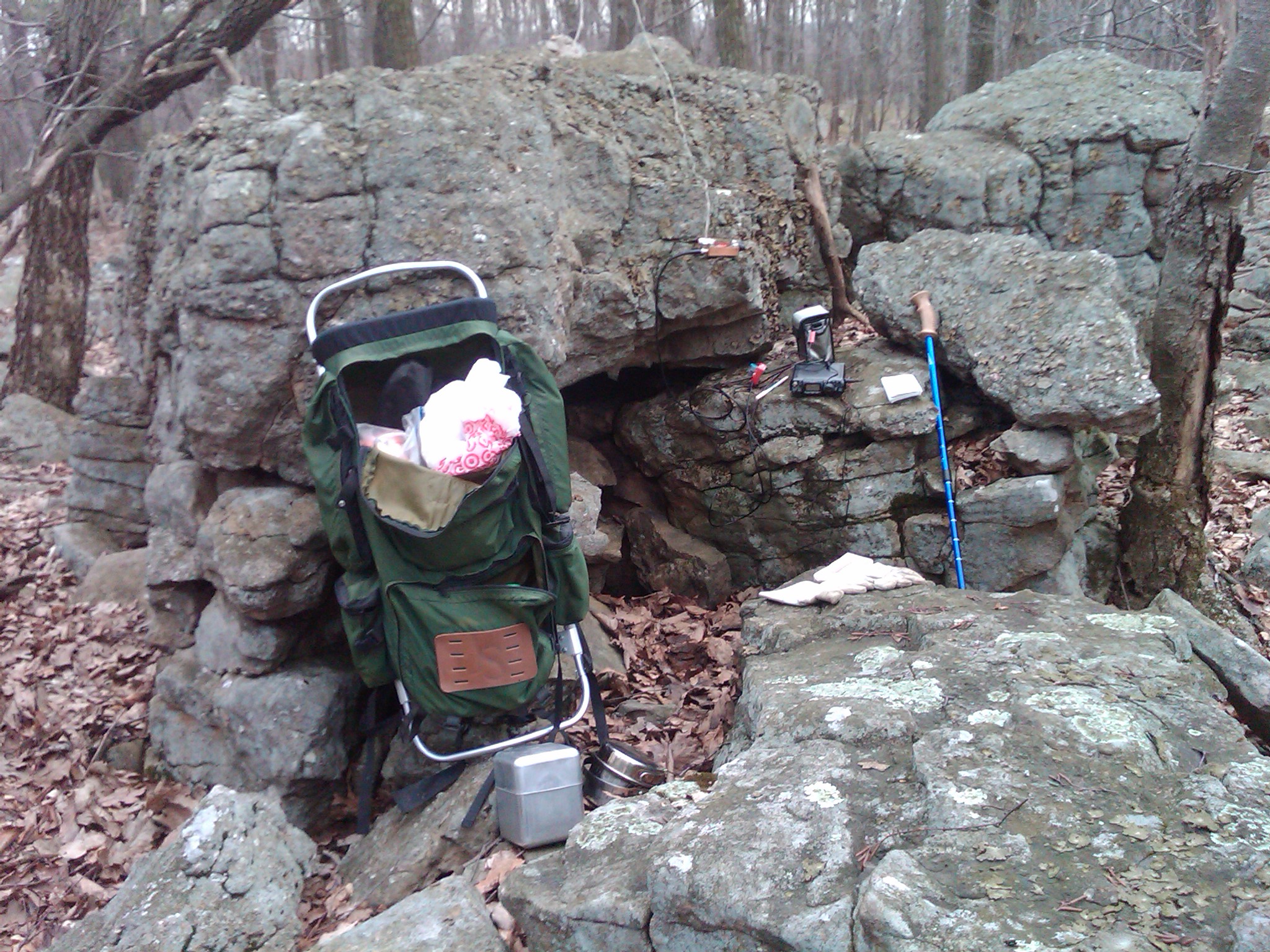
My rocky QTH

My portable station: an FT-817, BLT tuner, and modified Whiterook paddle
At this rate it will take some 250 summits to get to the famed Mountain Goat status, not considering bonus points for winter activations. There are only 220 summits in the W3 SOTA association, so quite a bit of travel and planning would be necessary to pull this off. But I’m in no rush :-)
 Radio Artisan